Video Comparison
TruLight vs Gemstone: The Full Breakdown
We put TruLight and Gemstone Lights side by side and compared everything: the LED chips, the voltage, the build quality, the app, and more. Here's what we found.
Jump to a Section
Here's the Bottom Line
Gemstone has been around a long time and helped build the permanent lighting industry. But the technology has moved forward. TruLight uses a superior LED chip, runs at 4x the voltage, and has an app with over 5x the motion patterns. The kicker? They're in the same price range.
2x the LEDs
TruLight uses 6 LEDs per node: 3 RGB plus 3 dedicated warm white. That hardware supports both warm white and a bright pure-white mode.
48V vs 12V
Higher voltage means fewer power injection points, simpler installation, thicker wiring, and more consistent brightness across longer runs.
144+ Patterns vs 27
Plus density control, background coloring, animation previews, true global zoning, and motion sensors. The app is where TruLight really pulls ahead.
Full Side-by-Side Specs
| Feature | TruLight | Gemstone |
|---|---|---|
| LED Chip | UCS7604 (RGBW) | WS2811 |
| LEDs Per Node | 6 | 3 |
| True Warm White | ||
| True Pure White | ||
| System Voltage | 48V | 12V |
| Wire Gauge | 16 gauge (thicker) | 18 gauge (thinner) |
| Wiring System | 4-wire (redundant data) | 3-wire |
| Expected Lifespan | 100,000 hours | 50,000 hours |
| Power Injection | Every 400 lights | Every 50-70 lights |
| Signal Redundancy | ||
| Track Material | Aluminum | Aluminum |
| Controller Ports | 4-port (always) | 4-port (Hub 2, new ~2025) |
| Motion Patterns | 144+ | 27 |
| Density Control | ||
| Background Coloring | ||
| App Animation Preview | ||
| True Global Zoning | ||
| Motion Sensors | ||
| Music Sync | Music manager + Bluetooth | Phone mic + local WiFi |
| WiFi + Bluetooth |
*True Warm White: Both systems produce a genuine warm white. Gemstone's comes from a smaller warm white section inside each color diode, which they market as a "quarter light." TruLight's is typically brighter because three full-size warm white LEDs at 48V put out more than three quarter-size sections at 12V.
*True Pure White: Pure white comes from driving the three color LEDs to a cool white with three dedicated warm white LEDs lifting underneath, all six at once. A warm white section that shares a color diode does not have the output to do that.
*Signal Redundancy: If a WS2811 light fails, the signal stops at that point. The UCS7604 has built-in chip redundancy plus a 4th backup data wire.
*True Global Zoning: Gemstone supports light selection and grouping, but not independent global zones with reverse patterns and separate controls.
What Does the Physical Puck Profile Look Like?
We photographed a purchased Bosso node beside a TruLight node at the same camera height. Bosso is on the left. TruLight is on the right. The raised three-lens Bosso housing uses the same visible form shown in the Gemstone dealer walkthrough. This is not a Gemstone product sample, and the photo does not establish that every internal component is identical.
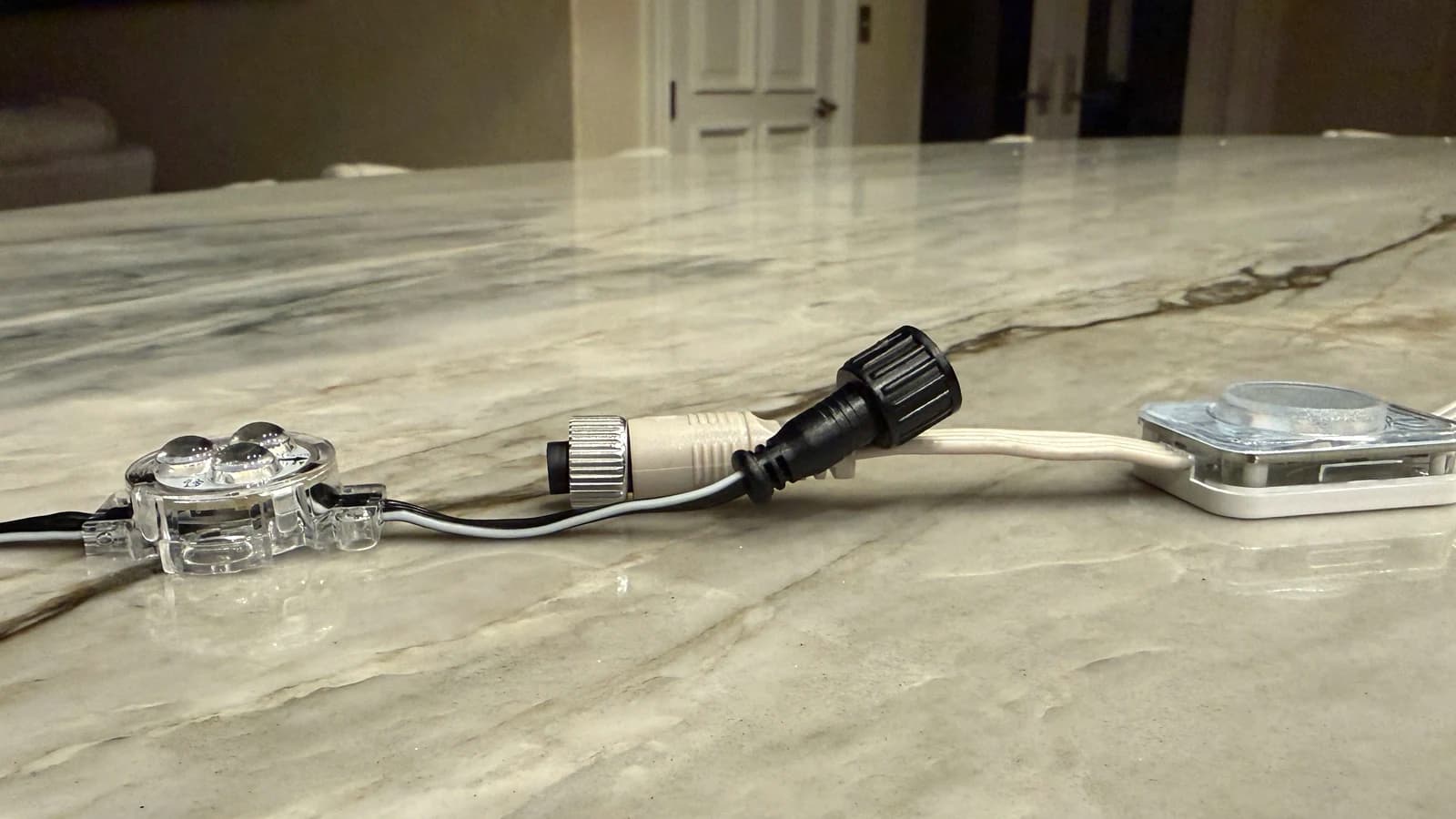
The three-lens 12V puck is also sold as a general permanent-track-light form factor. Current supplier listings advertise 12V, 30 mm RGBW point lights with three LEDs for permanent track installations. Similar exterior shapes do not mean the controller, track, warranty, app, or internal electronics are identical.
See a current 12V three-LED permanent track light supplier listingWhich LED Chip Is Better: WS2811 or UCS7604?
The UCS7604 is a 4-in-1 RGBW chip with 16-bit color depth (65,536 levels per channel) and native 48V support. The WS2811 is an 8-bit three-channel controller (256 levels) designed for 5V and 12V systems. The warm white section on these nodes rides along on that older platform rather than getting a channel of its own. The UCS7604 also has built-in signal redundancy, so if one light fails, the rest keep working.
Gemstone offers warm-white output. TruLight uses the UCS7604 with 6 LEDs per node: 3 RGB plus 3 dedicated warm white. That six-emitter design supports warm white and a bright pure-white mode.
Don't take our word for it. Google “WS2811 vs UCS7604” yourself and read what comes up. In the video, we did exactly that, and the results were clear.
See this comparison at 2:01 in the videoHow Does White-Light Capability Compare?
Gemstone offers warm-white output. Product generations and hardware configurations can vary, so confirm the exact light included in a current quote. TruLight has 3 dedicated warm-white LEDs per node, giving homeowners warm white plus a bright pure-white mode from the full six-emitter design.
TruLight co-owner Tom Porter says pure white is the setting customers most often tell him they use. This is owner-reported feedback, not app telemetry. It is a practical everyday setting for accent lighting, security lighting, and backyard entertaining.
See the white light comparison at 4:12 in the videoWhy Does 48V vs 12V Matter for Permanent Lights?
Voltage directly affects how far your system can carry power before needing an injection point. Gemstone's 12V system requires a power injection every 50 to 70 lights. TruLight's 48V system needs one every 400 lights. That's a big difference in real-world installation.
Fewer injection points means fewer wires running through your soffit, fewer potential failure points, and a faster, cleaner install. Think of it like a river: a larger river carries water farther before it trickles out. A 48V system pushes power and data much farther on each run, which is why TruLight uses heavier 16-gauge wire compared to Gemstone's thinner 18-gauge.
This also makes a real difference in brightness. In the video, we showed a side-by-side of a TruLight home next to a Gemstone home. The neighbor saw the difference, got a quote, and switched to TruLight. Gemstone's quote was actually $200 more for less technology.
See the voltage breakdown at 9:34 in the videoHow Do the Lights Hold Up? Build Quality Compared
In the video, we physically tested both lights. The Gemstone light has a plastic housing with thinner 18-gauge, 3-wire internals. The wire pulled right out by hand. TruLight's lights use a 16-gauge, 4-wire system in a housing that has been run over with cars and hit with hammers without breaking.
Both systems mount inside aluminum track, which is the standard you should expect. If any company is using plastic or acrylic track, that's a red flag. The WS2811 chip is rated for 50,000 hours. The UCS7604 is rated for 100,000 hours, double the expected lifespan.
See the build quality test at 5:13 in the videoWhich App Has Better Features and Controls?
TruLight's app has 144+ motion patterns compared to Gemstone's 27. Both apps let you adjust direction, speed, and brightness. But TruLight adds density control (how “busy” an effect looks) and background coloring (set a base color behind any effect). Gemstone doesn't have either.
TruLight also shows an animated preview of what each effect looks like on a house, right in the app, so you can pick the look you want without walking outside. Gemstone's app shows text of what's playing but no visual animation.
TruLight App
- 144+ motion patterns
- Density control
- Background coloring
- Animated house preview
- True global zoning
- Motion sensor zones
- Music manager with uploads
Gemstone App
- 27 motion patterns
- Density control
- Background coloring
- Animated house preview
- True global zoning
- Motion sensor zones
- Phone-as-mic music sync
What Is True Zoning, and Does Gemstone Have It?
Zoning is one of the most misunderstood features in permanent lighting. Many companies say they “zone,” but what they really mean is you can select individual lights and change their color. That's grouping, not zoning. TruLight offers true global zoning, where you create independent zones that can each run their own patterns, directions, and effects at the same time.
For example: your front yard can run a red, white, and blue chase for the Fourth of July while your backyard stays on a warm white for grilling. Or you can reverse the pattern direction in a zone so lights flow correctly on a peak that runs the opposite way. You can also assign a motion sensor to one zone so it reacts independently. Gemstone supports light selection but not this type of global zone control.
See the zoning breakdown at 26:55 in the videoStraight From the Video
“We run these over with cars. We hit them with hammers. These don't break.”
“They were actually $200 more expensive than your quote.”
“If they're using lumens to sell you, you're getting swindled.”
Ready to See the Difference?
Get your instant quote, then use our free preview tool to draw your roofline and see what TruLight looks like on your home. Same price range as Gemstone, with twice the technology.